Introduction
From a futuristic notion, artificial intelligence has become an integral part of our lives as a productivity enhancement tool. Whether you need to compose emails or create presentations, analyze papers, generate images, code applications, or conduct research, AI-powered applications have become part of our work and life.
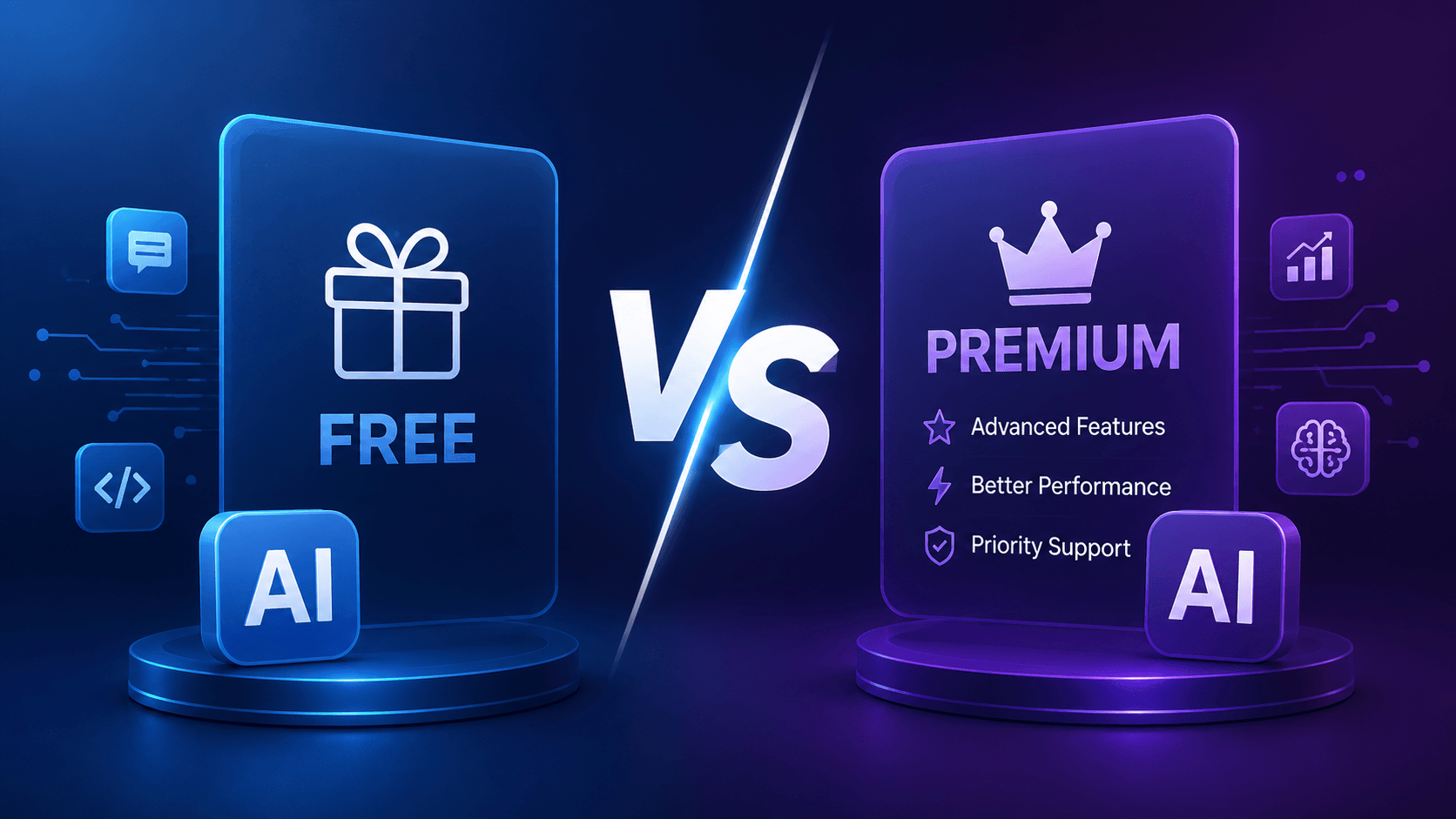
But as the AI market expands, users face an increasingly important question: should you stick with free AI apps or pay for premium features? In this blog, we will compare free vs paid AI apps.
Not necessarily. AI apps that are free, can be very powerful, while paid apps guarantee higher quality, more features, greater usage capacity, and improved models. Some users can benefit a lot from the paid AI app subscription, saving their time each week. Others may find that the free version is enough for their needs.
That means that the controversy between free vs paid AI apps is less about the superiority of the latter and more about its worthiness.
What Are Free AI Apps?
Most AI applications that are free normally allow users to access the main functions of the artificial intelligence software without having to subscribe. Based on the particular application used, users may be able to produce texts, summarize data, develop images, translate documents, brainstorm ideas, or conduct basic research.
However, free AI programs are not always unlimited.
A lot of providers impose constraints for their free users like limiting the number of messages one may send per day, reducing response time, restricting access to the advanced models, reduced ability to produce images, uploading files, or being blocked during peak times.
For normal users, such constraints would not really pose a major issue. For instance, someone who just wants an AI assistant to help him rewrite an email or come up with some ideas will have no compelling reasons to upgrade.
The primary benefit of free AI programs would, therefore, be accessibility.
What Do Paid AI Apps Offer?
Paying for best AI apps typically gives users the ability to use features which go beyond the free package. The specifics of those features may greatly differ from company to company, but they usually include higher usage limits, more advanced models, better response time, advanced reasoning, bigger files or context limits, image and video generation capabilities, enhanced research abilities, integrations, as well as priority access to all new features.
The difference that this can make for professionals and companies is rather significant.
Consider an example of a marketing professional who utilizes AI to analyze reports, create ideas for campaigns, write content, conduct research regarding customers, and create different versions of ads. In case the limitations of the free version become a problem, paying for the app can greatly reduce the friction involved and improve productivity greatly.
Free vs Paid AI Apps: What Is the Real Difference?
The most important differences usually fall into several categories.
1. Availability of Better AI Models
The main reason why most people consider upgrades is the availability of better models.
Free services can give you access to good models; however, for premium users, there might be models that are specially designed for complicated processes such as reasoning, programming, and analysis.
While this feature might not be noticeable by a casual user, for the user doing complicated work, this makes a big difference.
2. Usage Limitations
Usage limitations are yet another critical consideration.
A free service may seem to satisfy all needs until one starts working intensively with the AI software.
Premium services normally raise usage limitations.
If AI is an everyday tool for work, smoothness of its functioning alone may be sufficient reason to subscribe for it.
3. Speed and Availability
Slow reactions and limited availability are possible for free versions under heavy load.
If AI tools are needed only occasionally, the wait will probably not play any role. However, if an AI is actively used during a workday, response time can be regarded as productivity.
An employee that works for a couple of hours with an assistant every day will certainly find quicker availability much more valuable than somebody else.
4. Advanced Features
The third difference between free vs paid AI apps is that of features.
A paid plan might have features like advanced document analysis, larger context window, personalized assistant, advanced research, image creation, automation, AI integration services, and latest AI model.
Such features can transform a chatbot into a productivity tool.
When Are Free Apps Enough?
Not everyone requires top-tier AI.
If your AI usage is sporadic and straightforward, then you could very easily get by with free AI alternatives.
In fact, free AI is likely enough for:
- Brainstorming
- Rewriting small portions of text
- Writing captions for social media posts
- Summarizing smaller pieces of text
- Understanding basics
- Translating text from everyday life
- Making simple lists or outlines
- First-time testing out an AI service
These applications of AI may not benefit much from paying more.
The best course of action would be to try out the free version and see how you use it. Don’t pay up just because the premium option sounds fancy; make sure the free plan is restricting you.
When Are Paid AI Apps Justified?
If there is a direct link between AI apps and productivity, income or professional performance, the justification of premium is more evident.
For instance, let’s take a developer who uses AI in debugging, programming, document management, testing, and technical research. Even 30 minutes per day of savings can be quite valuable over the course of a month.
Likewise, an analyst may employ premium AI applications to work on extensive documents, gain insights, compare data and generate reports. A marketer may do market research, create content, analyze campaigns and personalize.
In these scenarios, the question isn't simply “How much does the subscription cost?”
It becomes:
How much value does the AI create compared with what I pay for it?
This is a much better way to evaluate whether AI app subscriptions are worth it.
AI App Pricing
In recent years, AI app pricing has become more varied. There are apps that offer cheap individual subscriptions, and there are apps that offer professional or business subscriptions that cost much more.
Before choosing an expensive subscription, think beyond its main monthly cost.
Think about:
Usage limits: How much can you really use the product?
Access to models: Do you have access to the necessary models within the plan?
Additional features: Are additional functions useful for you?
Integration: Can AI integrate into applications you use now?
Collaboration: If you are subscribing for your company, do you have the necessary collaboration tools?
Protection of data: Do you have data protection services for your business?
The cheapest AI subscription is not necessarily the best one.
Likewise, the most expensive one is not always the most useful one.
Hidden Cost of Free AI Applications
Free AI software has a clear benefit in the fact that it does not imply any subscription payments. However, that does not mean that there is no cost associated with free AI applications from the standpoint of businesses.
The real hidden cost could often be calculated through the amount of time wasted, limited features, and interruptions in workflow.
Consider the scenario where the employee has to waste additional time moving between different applications since they all have some restrictions. The employee could have to manually copy and paste information due to the lack of integration with other business applications.
That is why AI applications should be evaluated by their impact on productivity.
Premium AI Apps for Business
The significance of the assessment process is even higher if the deployment of the AI system involves the entire company.
Organizations might not need just an individual AI assistant. They might need security, management, workflow integration, analytics, user management capabilities, and connections with internal systems.
AI Integration services might be quite helpful here.
Rather than subscribing to individual premium applications, the companies would be able to embed AI functions into their own applications and processes. AI can be integrated with CRM systems, procurement systems, customer support systems, knowledge base systems, ERP systems, and any other business applications.
The goal will no longer be to give the AI tool to the employees.
Instead, AI will be integrated into the infrastructure of the business itself.
Such an approach could bring more value to the company than individual subscriptions to various AI applications by the employees.
How to Decide If a Premium AI App Is Worth It?
There is a simple way to evaluate this problem.
First, find out how often you use the AI application. In case you don't use it often, a free version is enough.
Second, find out the limitations that you experience. Do you face usage restrictions? Do you need another model? Do all useful features belong to the premium plan only?
Third, estimate the value of added features.
For example, if the premium subscription will cost you $20 per month, but it will save you two hours a month of your work time, calculate the value of these two hours. For professionals, who have valuable time, this problem may become quite economic.
Fourth, think about personal and business needs. Business requirements are often associated with security, integration, management, etc.
Free vs Paid AI Apps: Which Should You Choose?
There is no absolute winner between free and paid AI applications.
Free apps can be used to explore, play, and work where there is a minimal chance of hitting restrictions on the number of uses.
Paid apps tend to be more appealing as soon as there is a demand for increased usage, improved models, performance, and functionalities.
A useful rule is:
Don't pay for AI because premium exists. Pay for AI when premium solves a problem you actually have.
This prevents users from accumulating multiple AI app subscriptions that they rarely use.
The Future of AI App Subscriptions
AI is quickly changing in the marketplace. Those aspects of a plan that were previously only available to users paying for premium services are now being included in the free plan, and premium services keep getting smarter and adding more features.
Users will become choosier when it comes to maintaining subscriptions as the competition increases.
The future will bring less standalone AI applications and AI implemented directly into the software.
Rather than using a standalone AI application, the user could be communicating with the AI directly from an email client, accounting service, procurement service, CRM, programming environment, or project management application.
In this way, the role of AI implementation becomes increasingly important.
Instead of making employees use several separate paid AI applications, the business can use AI integration services.
Concluding Thoughts
Thus, is it worthwhile to spend money on premium AI apps?
In case of occasional use, probably not. In case of intensive use and professional work, likely yes. For companies, it will depend on the process itself and generated value.
The most useful AI applications are not always the ones with the most features on their list. They are the ones which solve actual problems efficiently and effectively.
AI apps that are free are perfect for starters. They let users familiarize themselves with artificial intelligence free of charge and are capable of performing a lot of routine tasks.
Premium apps become reasonable when limitations start influencing efficiency or when advanced options create added value.
After all, the correct choice of a solution depends on the amount of use, user needs and profitability. Analyze the chosen premium apps, consider the true AI app subscription price, and compare it to potential productivity and value.
The purpose should not be to buy the most AI subscriptions possible.
It should be to have the proper AI options needed to perform your tasks.