Blog Summary
Explore mobile app market size, share, and growth trends while learning how mobile app testing, quality checks, and pre-launch strategies improve app performance, security, reliability, and user experience.
Mobile apps have become one of the crucial parts of the digital economy. Modern smartphones can offer services such as banking, retail, entertainment, healthcare, education, and business.
Such increased reliance is contributing to the increasing demand for mobile app development. Mobile app testing is becoming necessary due to the growing demand.
The size of the worldwide mobile application market reached approximately $298.4 billion in 2025. It is expected to attain $1.02 trillion by 2034. It will account for a CAGR of 15.1%. The Asia Pacific region accounted for 52.92% of the total market share in 2025.
Other research also shows strong growth. One forecast estimates the market at $243.84 billion in 2025. It expects the market to reach $543.87 billion by 2030. That represents a 17.4% CAGR.
These estimates use different market definitions. Still, both show strong long-term expansion.
Mobile App Market Size and Growth
The use of mobile applications has evolved from merely being devices for communication purposes to becoming complete digital business models.
Users use mobile applications for shopping, subscription services, payment purposes, social interactions, and entertainment. Companies also use them for their customer service processes and for conducting their business processes.
By the end of 2025, the total number of global mobile application downloads is estimated at approximately 150 billion. The total expenditure on mobile applications globally has been estimated to be around $167 billion by the end of 2025.
India is one of the most prominent mobile application download markets. China is one of the most prominent mobile application revenue markets.
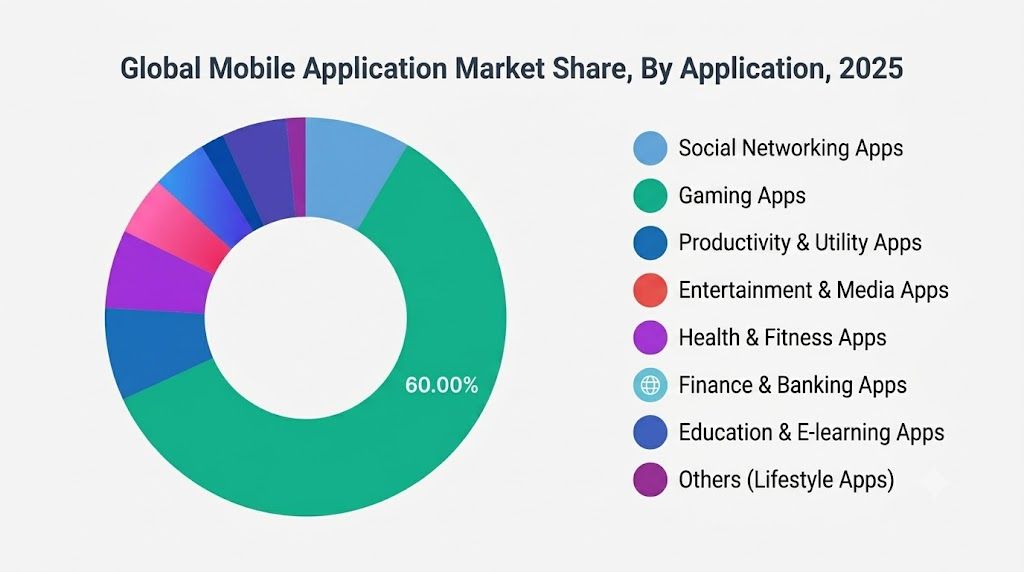
Mobile App Market Share by Platform
Android and iOS remain the two dominant mobile platforms. Their market positions differ by region and business model.
Android has a wider global device footprint. It is especially strong across emerging markets.
iOS has a smaller global device base. It has strong commercial value in many high-spending markets.
App developers must consider both platforms when defining their development strategy. Platform selection should depend on target users, geography, budget, and monetization goals.
| Market Factor | Android | iOS |
| Global device reach | Very high | High |
| Device fragmentation | High | Lower |
| Hardware variety | Very high | More controlled |
| Testing Complexity | Higher | Moderate |
| Premium user segments | Strong | Very strong |
| OS/device combinations | Many | More controlled |
| Key testing concern | Compatibility | Version and device coverage |
The market also includes cross-platform development. Frameworks can help teams target multiple platforms with shared code.
Yet shared code does not remove the need for platform-specific testing. Native features can behave differently across devices.
What Is Driving Mobile App Market Growth?
There are a few trends that contribute to further market growth.
1. Popularity of Smartphones
Smartphones remain one of the key tools for digital communication. It is expected that all services will be available via special apps.
This trend will contribute to the development of demand in retail, financial, healthcare, educational, and entertainment sectors.
2. Increase in Speed of Mobile Internet
5G network allows for an enhanced mobile experience. There is a chance to enjoy streaming, gaming, voice calls, cloud applications, etc. via faster mobile Internet.
More complex apps are enabled via improved connectivity.
3. Mobile Commerce
Mobile commerce is becoming one of the key trends in the field of mobile app development. Apps can provide customers with discounts and facilitate payment procedures.
It is very beneficial for retail and fintech firms.
4. Artificial Intelligence
Artificial intelligence is becoming one of the core aspects of mobile application development. It is used for creating AI assistants, recommendation engines, image recognition features, and other functions.
Apps using artificial intelligence require special tests. Response accuracy, latency, security, and fault tolerance should be tested.
5. Subscription Models
Many mobile applications earn money via subscription plans. Fitness, entertainment, productivity, and education apps mostly use this model.
Good retention is based on app quality. Performance issues lead to quick uninstalls.
Why Mobile App Testing Matters
As the market grows, the competition between applications also increases. Having an amazing idea is not enough.
Users need a quick interface, easy navigation, secure payments, and reliability.
This means that testing the mobile app becomes one of the essential stages of its development.
The process of testing must start during development and end after the release.
Proper testing lowers the probability of crashes and problems in the application. At the same time, it helps to maintain the company's reputation.
How to Test a Mobile App
How do we test a mobile application efficiently?
First of all, focus on the most critical user scenarios. Test the paths that are relevant to the purpose of the app.
For example, for an e-commerce application, test the registration, searching, product choice, checkout, and payment.
For a banking application, test login, accessing your account, transferring, and transaction history.
The procedure must include several types of testing, which are as follows.
Functional Testing
Functional testing is where you test whether functions work as they are expected to.
Test input forms, buttons, navigation, login/logout, payment features, notifications, and data handling operations.
Test both success and failure scenarios.
UI/UX Testing
UI/UX testing refers to testing the appearance and usability of the application.
Fonts, color schemes, buttons, spacing, layouts, icons, and navigation must be tested.
Tests need to be conducted for different screen sizes and orientations.
Performance Testing
Performance testing refers to testing the performance of the application.
Application performance needs to be tested in terms of load times, responsiveness, memory usage, network traffic, and battery drain.
Test your application on high- and low-end devices.
Compatibility Testing
Compatibility testing confirms whether the application works on different types of hardware, software platforms, and varying screen resolutions.
This is particularly essential in case of Android application testing since device fragmentation can bring out some issues that go unnoticed in normal testing.
Security Testing
Security testing helps ensure that the user and application data stay safe.
Perform security testing to check authentication, authorization, security of stored data, network connections, sessions, and any exposed sensitive information.
Security testing should be performed prior to release.
Usability Testing
Usability testing emphasizes user behavior.
The user should be able to navigate easily without much guidance. Forms should be user-friendly.
Accessibility also needs to be taken into account when performing usability testing.
Regression Testing
Regression testing verifies the working features after modification.
An added feature can unintentionally disrupt an existing feature. Regression testing will help in identifying such issues before releasing the product.
Real Device Testing
Testing on a real device is necessary for mobile applications.
Simulators and emulators can be helpful during the development phase. But they may not mimic all real-time situations.
Test your application workflows using real physical devices. Include different sizes and processing capabilities.
App Crash Testing
App crash testing verifies the behavior of an application during failure scenarios.
Network failure, backgrounding, insufficient memory, interrupted processes, and wrong inputs are some scenarios that need testing.
The objective is not only to make sure that the application does not fail. The application should recover from failures as well.
Mobile App Testing Checklist Before Launch
A structured mobile app testing checklist can make release testing more consistent.
Here is a practical app testing checklist for development teams:
- Test installation and uninstallation.
- Test first launch and onboarding.
- Test login and account recovery.
- Test all major user journeys.
- Test valid and invalid inputs.
- Test navigation and back actions.
- Test notifications and deep links.
- Test portrait and landscape layouts.
- Test different screen sizes.
- Test supported OS versions.
- Test on real Android and iOS devices.
- Test slow and unstable networks.
- Test offline behavior.
- Test app background and resume behavior.
- Test memory and battery usage.
- Test app startup performance.
- Test security controls.
- Test accessibility features.
- Perform regression testing.
- Perform app crash testing.
- Review analytics and error reporting.
- Complete beta testing.
- Test the final production build.
- Verify store assets and release information.
Current pre-release guidance also emphasizes permissions, offline behavior, device coverage, accessibility, performance, security, and store readiness.
App Testing Before Launch
Pre-launch app testing must be done on the final version of the application.
Testing on some other version that was developed earlier is not enough. There can be changes in configuration, APIs, certificates, analytics, and other aspects of production.
The final build must be successfully tested for functionality, performance, compatibility, security, and usability.
There should be definite pass and fail criteria for tests. Each critical defect must have an owner and a resolution plan.
Pre-Release App Testing and Beta Testing
Application testing before release is a combination of QA and feedback from real users.
In addition, beta testing offers additional validation. The selected users test the application under normal usage conditions.
User feedback may highlight workflow problems as well as hardware problems.
Beta testing should not be a substitute for the QA process but should supplement it.
Teams can apply user feedback to make decisions on fixing applications before launch.
The Future of Mobile App Development
The mobile application market is entering a larger and more competitive phase.
AI, 5G, mobile commerce, cloud services, and connected devices will support further growth.
This growth will also raise expectations for quality.
Users will have many alternatives if an app is slow or unreliable. Developers must therefore treat testing as part of product development.
A strong mobile application testing strategy can reduce release risks. It can also improve customer satisfaction and retention.
Conclusion
There is tremendous scope for growth in the market for mobile app development.
Existing projections suggest that the market will be worth hundreds of billions of dollars.
Both downloads and expenditures will stay high, with markets like India and China continuing to be at the heart of global developments.
There is also increased competition as part of this opportunity.
Companies require applications that are secure, reliable, fast, and easy to use, which necessitates mobile app testing.
One such useful checklist would include functional testing, UI/UX testing, performance testing, compatibility testing, security testing, and usability testing.
Additional methods for testing include real-device testing, regression testing, application crashing testing, and beta testing.
There is one simple yet robust method that developers can use to create successful apps. Build the product for the market and test it with actual users before releasing it to the market.