Introduction
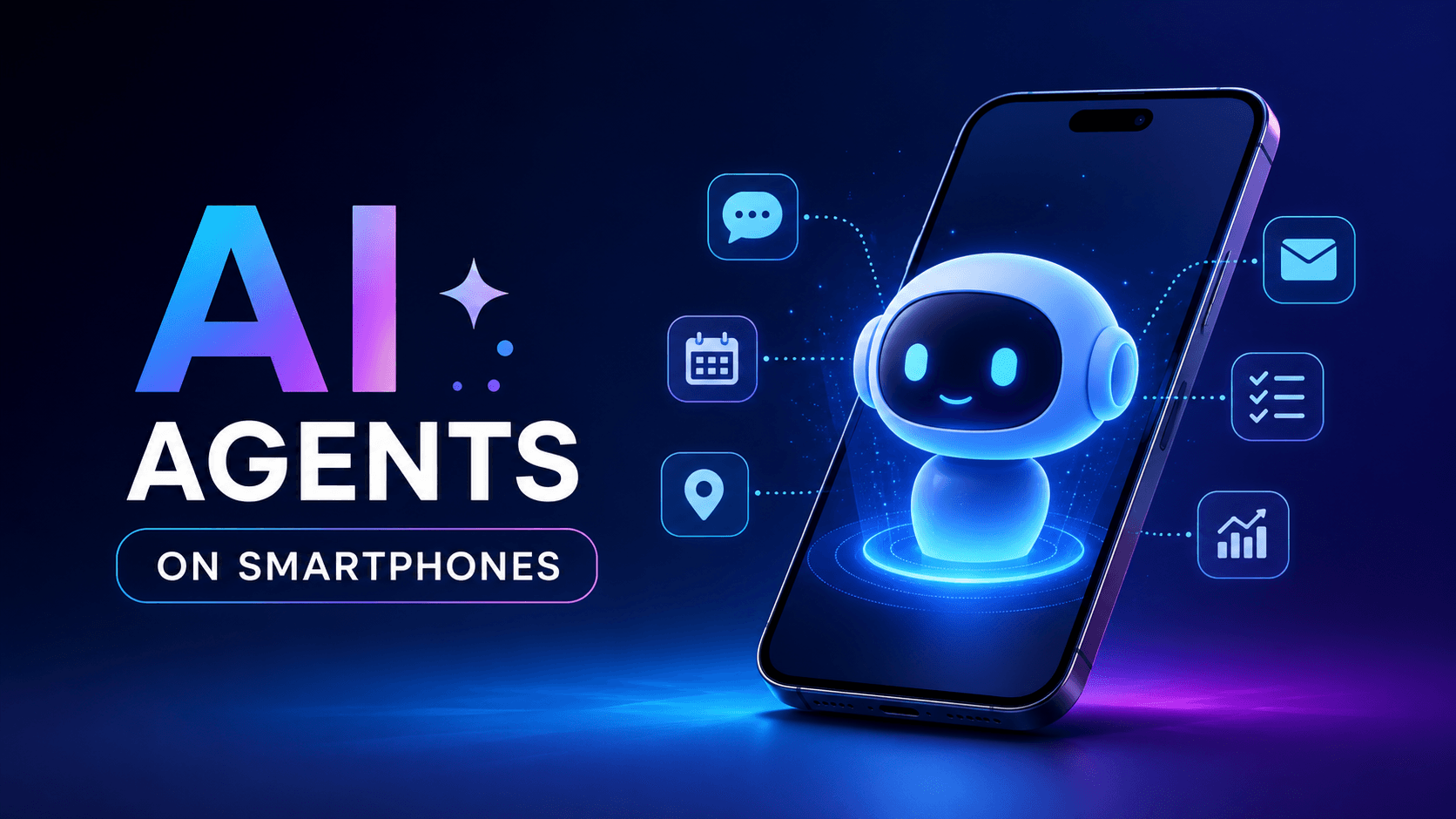
In comparison with classic voice assistants, which just react to orders, the new generation of AI agents on smartphones can recognize context, save user preferences, perform actions automatically, and even make decisions instead of users. From scheduling appointments to modifying photos, such agents are making smartphones more intelligent than ever.
In this blog, we will explore how AI Agents Work, and why they represent the next major leap in Smartphone Technology.
Scope of AI Agents
AI agent is a software program capable of perceiving information, analyzing it, making decisions, and taking actions.
Whereas traditional applications take commands from the user, AI agents can:
- Interpret user intentions
- Learn from the user’s behavior
- Plan several actions at once
- Perform actions autonomously
- Evolve to better performance
In the case of smartphones, it means that an AI agent can execute a series of actions instead of single commands.
For example, instead of asking, "Set an alarm.", a user might say, “I have an early flight tomorrow.”
The AI agent can automatically check your calendar, look at traffic conditions, suggest when to leave, set multiple alarms, monitor your flight status, and remind you to charge your phone.
This level of intelligence goes far beyond traditional automation.
Working of AI Agents on Smartphones beyond traditional automation.
Understanding how AI Agents Work begins with examining the technologies working together behind the scenes.
1. Understanding Context
The AI agent always gathers information about your surroundings from various sources within your smartphone, like the following:
- Calendar
- Emails
- Messages
- Location
- Weather
- Apps' usage
- Contacts
- Your health data (with permission)
- Device settings
Instead of analyzing each application separately, AI forms a holistic perception of your surroundings.
For instance, if you get an appointment, your smartphone AI can determine all information about that appointment.
In case of traffic, AI will notify you about leaving early.
2. Realizing Intent
Modern AI agents rely on Large Language Models (LLMs) combined with contextual understanding.
Instead of matching keywords, they interpret what users actually mean.
For example, a user says: “I am running late”.
The AI doesn't simply display search results.
Instead, it understands possible intentions:
- Notify meeting attendees
- Share live location
- Open navigation
- Calculate arrival time
- Suggest a faster route
Intent recognition makes interactions far more natural.
3. Planning Actions
That is how AI agents are different from traditional assistants.
Instead of following instructions, they create a plan.
Suppose a user says,
“Make plans for dinner with Sarah this Friday.”
Then the AI agent may
- Check their schedule
- Find out availability
- Recommend a restaurant
- Determine the travel time
- Make a calendar entry
- Write an email
- Book a table
- Include navigation details
That entire process is just agentic planning.
4. Executing Tasks
Once the plan is created, the AI interacts with apps and services.
Depending on permissions, it may:
- Send messages
- Create reminders
- Book reservations
- Organize photos
- Generate documents
- Summarize emails
- Translate conversations
- Launch apps
- Complete forms
Many smartphone manufacturers now provide APIs allowing AI agents to communicate across applications securely.
5. Learning User Preferences
AI agents keep improving as a result of interacting.
In time, they come to know about the restaurants that you like, the people that you call often, your commute patterns, favorite applications, your schedule, style of writing, and music preferences.
Role of On-Device AI Processing
One of the biggest advancements in modern smartphones is On-device AI processing. Instead of sending every request to cloud servers, many AI tasks happen directly on the phone.
Benefits include:
Faster Responses
Responses are faster compared to cloud-based applications.
No internet delay
There is no lag because of a slow internet connection on your device.
Commands execute almost instantly
Execution of commands takes place in real time.
Better Privacy
Sensitive information remains on the device instead of being uploaded.
Examples include:
- Personal photos
- Voice recordings
- Notes
- Messages
- Health data
Functionality
Many AI capabilities can work without Internet access. Some of these capabilities are voice recognition, image editing, and translation.
These include:
- Voice recognition
- Image editing
- Translation
- Smart search
- Text summarization
Lower Power Consumption
AI-powered chips optimize processing but minimize battery usage at the same time.
Hardware Behind AI-Powered Smartphones
AI-enabled smartphones have been built with specialized hardware which is used for handling AI-related tasks.
Such hardware includes:
Neural Processing Unit (NPU)
This chip handles machine learning tasks such as:
- Face recognition
- Speech recognition
- Image enhancement
- Object detection
- Language understanding
Whereas CPUs process machine learning algorithms inefficiently, NPUs handle billions of AI operations.
Graphics Processing Unit (GPU)
Graphic cards help to handle:
- Image generation
- AI photography
- Video enhancement
- Computer vision
Specialized Memory
In addition, modern smartphones have fast memory dedicated to AI tasks.
Now, let’s discuss what is the technology behind AI agents on smartphones.
Technology Behind AI Agents on Smartphones
Several technologies combine to provide intelligent mobile experiences.
Natural Language Processing (NLP)
NLP enables smartphones to understand:
- Spoken language
- Written text
- Context
- Intent
- Sentiment
Instead of recognizing words alone, NLP extracts meaning.
Machine Learning
Machine learning enables continuous improvement of AI systems through experience.
Examples include:
- Personalized recommendations
- Keyboard predictions
- Smart replies
- Photo categorization
Computer Vision
Computer vision helps smartphones understand images and videos.
Applications include:
- Face detection
- Document scanning
- Object recognition
- Visual search
- Augmented reality
Generative AI
Generative AI enables:
- Email writing
- Image generation
- Text summarization
- Content rewriting
- Code generation
These capabilities are increasingly available directly on smartphones.
AI agents are unique and make them different from AI assistants.
AI Agents vs AI Assistants
Many people may get confused between AI agents and AI assistants, but they have some primary differences.
| AI Assistants | AI Agents |
| Respond to Commands | Complete Workflows |
| Limited Memory | Long-term Context Awareness |
| Single-step Tasks | Multi-step Planning |
| Wait for Instructions | Proactively Suggest Actions |
| App Specific | Work Across Multiple Apps |
| Basic Automation | Autonomous Decision-making |
Traditional assistants answer questions, but AI agents accomplish goals.
Smartphone Features Powered by AI Agents
Modern Mobile AI features already have AI agent capabilities.
Smart Notification
AI emphasizes important notifications without causing any distractions.
AI Photo Enhancement
The agents do the following automatically:
- Remove unwanted objects from images
- Improve lighting
- Blur the background
- Organize albums
Live Translation
Translating conversations into other languages takes place live.
Voice Transcription
Instant transcription of meeting notes and call recordings is possible.
Smart Email Assistance
AI agents can:
- Summarize emails
- Draft responses
- Find action points
- Prioritize emails
Travel Assistance
The smartphone could help you:
- Check flight details
- Pick departure timings
- Select hotels
- Modify travel itinerary
Health Monitoring
Analysis of wearable device and smartphone data helps in:
- Tracking activities
- Analyzing trends
- Improving health habits
Security and Privacy Considerations
AI agents process significant amounts of personal information.
Manufacturers address this through several security measures.
- Permission Controls: Users decide which apps and information AI may access.
- On-Device Processing: Keeping AI computation local reduces exposure of sensitive data.
- Encryption: Data remains protected during storage and communication.
- Secure Hardware: Many smartphones include dedicated secure enclaves for protecting AI-related information.
We have seen how AI agents work on smartphones and what features they have. Now, let’s have a look at the advantages they provide.
Advantages of AI Agents
The increasing use of AI agents in smartphones offers some benefits.
Productivity Enhancement
Automation of repetitive processes.
Users save time while switching from one application to another.
Personalization Improvement
AI accommodates personal preferences instead of making generic suggestions.
Accessibility Enhancement
AI helps the user by:
- Voice commands
- Captioning
- Object detection
- Assistance in reading
Creativity Enhancement
AI helps in:
- Creating content
- Editing images
- Creating music
- Making videos
Saving Time
Complex processes that were earlier possible using different applications are now possible with just one command.
AI agents provide several features and advantages to smartphone users. At present, there are some challenges that need to be addressed.
Challenges Facing Smartphone AI Agents
Despite rapid progress, several challenges remain for smartphone AI agents. Some of these challenges are as follows:
Privacy Concerns
Users may worry about data collection, continuous monitoring and cloud processing.
Greater transparency will remain essential.
Battery Usage
Advanced AI models need high computational power.
Better AI chips are constantly enhancing battery performance.
App Integration
All apps may not yet have the capability for automation using AI agents.
Developer usage will lead to more functionality.
Accuracy
There are times when AI agents misinterpret the situation.
Human oversight remains important for sensitive tasks.
We have discussed in detail AI-powered smartphones. Now, let’s have a look at their future.
Future of AI Smartphones
The next generation of AI smartphones will become even more autonomous.
Expected innovations are:
- Completion of purchases by AI agents
- Automation of travel
- Intelligent money management
- Smart health advising
- Language interpretation
- Personalized learning
- Cross-device AI environments
Future phones will be more like digital employees than just telecommunication tools.
Instead of launching applications, users will give their intentions, while AI takes care of everything else.
Conclusion
The appearance of AI assistants on smartphones is an important step in the evolution of mobile devices. AI assistants are different from traditional assistants in the sense that they understand context, do various things, recognize users' preferences, and automate complex processes. With the emergence of various innovative technologies like Smartphone AI Technology, On-device Processing, Machine Learning, and Generative AI, smartphones have become more advanced.