Introduction
The evolution of mobile application development is not limited to purely functional purposes. Businesses, these days, depend on applications that boost user interaction, automate operations, increase revenue, and build brand loyalty. Regardless of whether the app you want to build targets consumers, serves an enterprise solution, or helps a start-up, its chances of success will depend on the choice of the right app development agency.
Numerous development agencies advertise their outstanding service offering, but not all of them can turn the concept into a practical, reliable, and user-friendly application. Choosing the wrong developer may result in delays, cost overruns, bad coding practices, and maintenance issues in the future.
The search for the right application development company becomes simpler when realizing that price and portfolio matter.
Choosing the Right Development Partner- Key Factors to Consider
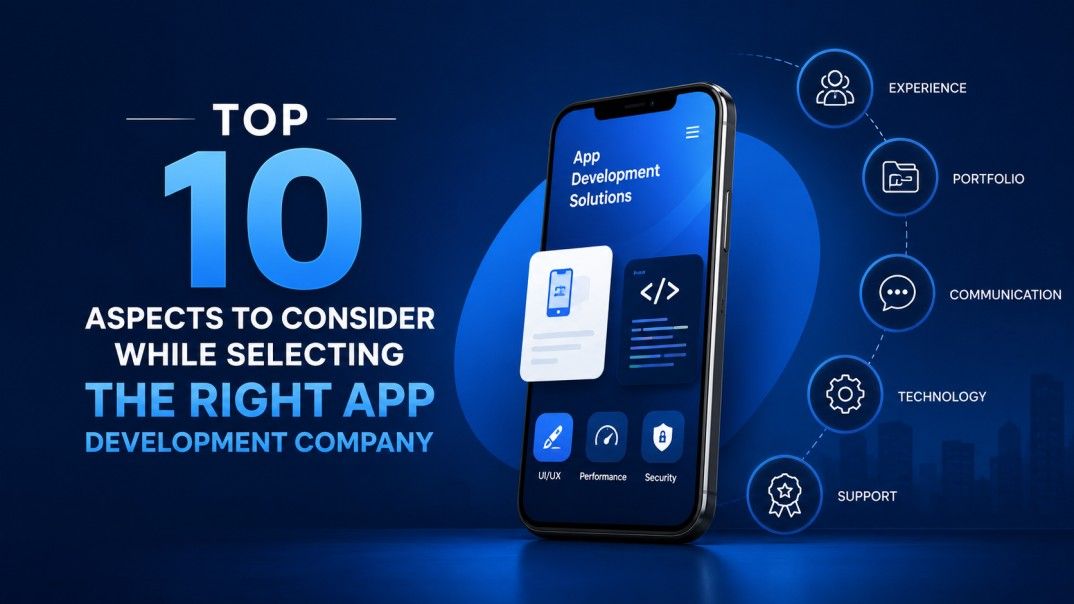
Here are the top ten points modern businesses should consider before selecting the most suitable mobile app development company.
1. Technical Expertise and Technology Stack
Technical skills are some of the most important qualities of app developers.
The technical skills of the agency's in-house professionals define its ability to create a reliable app. It is, therefore, necessary to ensure that the company has some experience working with those technologies your project requires.
You can check for
- Native application development
- Cross-platform frameworks
- Backend development
- Cloud infrastructure
- API integrations
- Database architecture
- Security implementation
A leading mobile app development company should understand current technologies. It should be capable of recommending the most suitable architecture based on your business objectives instead of pushing a preferred technology stack.
2. Industry-Specific Experience
It is fair to say that experience within your industry can reduce project risks significantly.
Here is an example. A healthcare app is different from retail, logistics, fintech, or educational apps. Industry experience assists developers in understanding the compliance issues and user demands in advance. For example, in this case, a healthcare-experienced development team will know about the HIPAA issues, while fintech-experienced teams will know about payment security.
Experience in the related industry will mean that there will be a seamless development process.
3. Portfolio Quality Beyond Visual Design
A portfolio should demonstrate business outcomes, not just attractive interfaces.
Entrepreneurs may consider screenshots and visual aesthetics. However, when user experience matters, the real value of apps lies in the performance.
You can examine several aspects while reviewing a portfolio, including
- Application complexity
- Scalability requirements
- Performance characteristics
- User adoption metrics
- Business objectives achieved
- Long-term maintenance
A reputable application development company can explain how its app solutions addressed specific business challenges instead of showcasing designs.
4. Development Process and Project Management
A structured process often predicts project success.
One of the biggest reasons app projects fail is poor communication. Erroneous project management is another major reason. A clear development roadmap assists in improving accountability, transparency, and consistency.
Some questions you may ask a potential mobile app development service provider are about
- Agile development
- Sprint planning
- Progress reporting
- Quality assurance
- Stakeholder communication
- Change process management
Development companies can accomplish app projects with effective project management skills and transparency.
5. User Experience (UX) and User Interface (UI)
Successful apps require more than advanced technology.
Even feature-rich applications can fail with difficulties in navigation. Modern-day customers need simple and fast-to-use applications.
A reliable mobile application development company should possess the following capabilities:
- User journey mapping
- Wireframing
- Interactive prototypes
- User experience standards
- Design Consistency
- Usability Testing
The best mobile applications work effortlessly, as a lot of effort has gone into their development.
6. Scalability and Future Readiness
Applications are always dynamic, and so are business requirements.
Many businesses select a development partner based solely on immediate requirements. However, successful applications often evolve rapidly after launch. New features, increased traffic, integrations, and geographic expansion put pressure on poorly designed systems.
It is, therefore, necessary to evaluate whether the company can build solutions that support:
- Traffic growth
- Additional features
- Third-party integrations
- Multi-region deployment
- Performance optimization
- Infrastructure scaling
One of the most common mistakes businesses make is choosing a vendor that can build a minimum viable product but lacks the expertise to support long-term growth.
7. Security and Compliance Standards
Security is the top priority these days.
It is because data breaches can damage customer trust, create regulatory issues, and result in financial losses. Your application handles highly sensitive information. This is a reason why you need to make sure that security practices are embedded throughout the development lifecycle.
Here are some security-related areas you can consider-
- Secure coding practices
- Vulnerability testing
- Authentication frameworks
- Data encryption
- API security
- Compliance readiness
A trustworthy development company discusses security aspects proactively. It never waits for clients to raise concerns.
8. Communication and Cultural Compatibility
Clarity in communication decides whether the project will succeed or fail.
Sure, technical skills play a role, yet cooperation matters the same. Application development projects always include continuous conversations, shifting priorities, feedback loops, and decision-making processes.
When looking into a particular organization, therefore, you need to take into account:
- Responsiveness
- Communication methods
- Time zone match
- Transparency
- Problem-solving approach
- Collaboration tools
Companies usually underestimate the significance of cultural fit. Teams that can discuss matters easily and have the same expectations develop ideas in a better way.
9. Post-Launch Support and Maintenance
Launching the application is merely the beginning of the process.
Many people believe that after deploying the application, the development process comes to an end. Actually, what happens after launching might dictate the fate of the app.
This is a reason why the application requires
- Performance tracking
- Security Updates
- Bug fixes
- OS compatibility updates
- Feature enhancement
Companies often understand too late that the development partner offers limited support after deploying apps. Before concluding a deal, you need to clarify maintenance models, response times, and support availability. An experienced mobile application development services provider considers support as an ongoing partnership approach.
10. Cost Transparency and Value
Cost is important, but value is even more important.
Opting for the lowest-cost provider can be expensive in the long run in terms of technical debt, performance issues, or complete redevelopment.
Instead of focusing on project cost completely, it is better to evaluate:
- Pricing structure
- Scope clarity
- Resource allocation
- Delivery timelines
- Support inclusions
- Long-term value
Higher initial investment leads to better architecture, greater security, more scalability, and reduced maintenance expenses.
What we found is that companies never regret investing in quality development; what they regret is choosing the cheapest option.
Comparing Strategic and Transactional Development Partners
The difference between a strategic partner and a transactional vendor becomes apparent as projects grow.
| Evaluation Area | Strategic Development Partner | Transactional Development Vendor |
| Business Understanding | Focuses on objectives and outcomes | Focuses primarily on tasks |
| Technology Guidance | Recommends optimal solutions | Implements requested features only |
| Scalability Planning | Designs for future growth | Builds for current requirements |
| Communication | Proactive and collaborative | Reactive and limited |
| Long-Term Support | Continuous engagement | Minimal post-launch involvement |
| Innovation | Provides recommendations | Executes instructions |
Businesses that regard development as an investment have higher success rates since they tend to choose good partners instead of service providers.
Red Flags to Consider
There are certain warning signs that one must consider when choosing the right development partner.
It is better to remain cautious if an application development company
- Guarantees unrealistic timelines
- Avoids discussing security
- Cannot explain its development methodology
- Lacks client references
- Offers significantly lower pricing than competitors
- Provides vague project estimates
- Demonstrates limited technical depth
These issues may indicate process weaknesses that could impact project success later.
Final Thoughts
Finding the right mobile app development company is one of the most crucial decisions. Companies have to make this decision to drive digital transformation. An ideal development partner provides companies with strategy consultation. This consultation is beneficial for reducing risk, enhancing user experiences, increasing scalability, and ensuring proper technology choices. This can help companies achieve their goals.
When companies focus solely on costs when selecting development firms, they fail to consider a range of other essential factors. Such elements include domain expertise, communication skills, industry knowledge, security capabilities, scalability, and support after launch. The right app development firm can help you leverage all these characteristics through a robust application.